
How to Get More from MediMan Telehealth Today
MediMan telehealth is designed to make high-quality healthcare more accessible, especially when you are juggling work, family, and travel. With the MediMan platform, you can discover trusted doctors, book video or in-clinic appointments, receive e-prescriptions, and manage family records in one secure app.
However, simply downloading the app and booking a video call is not enough to unlock the full value proposition. The quality of your MediMan telehealth experience depends heavily on how you prepare, how you show up to the consultation, and how you leverage post-consultation workflows like digital prescriptions, follow-ups, and remote monitoring.
This article provides a practical playbook for patients and caregivers who want to treat MediMan telehealth as a core part of their long-term health strategy, not just a backup plan when clinics are busy. You will learn how to master the platform, optimize your tech environment, bring the right medical information, communicate clearly with doctors, and use MediMan telehealth as a continuous care hub. Follow these steps and every virtual visit can become more efficient, more clinically meaningful, and better aligned with your lifestyle.
Why MediMan Telehealth Matters in a Hybrid Care World
The shift from traditional clinics to hybrid digital care
Globally, telehealth has evolved from a niche experiment into a mainstream channel for delivering healthcare. Leading health organizations describe telehealth as the use of digital technologies to deliver healthcare services and manage health remotely, covering video consultations, remote monitoring, and secure access to records. Evidence across countries shows that telehealth can improve access, reduce unnecessary travel, and deliver comparable clinical outcomes for many conditions, especially follow-ups, chronic disease management, and mental health.
For patients, this shift is more than just convenience. It means less time off work, fewer hours in traffic, and more timely interventions before minor concerns become major complications. For healthcare systems, it unlocks capacity, allowing clinicians to prioritize in-person slots for cases that truly require physical examination or procedures.
Where MediMan telehealth fits in your real life
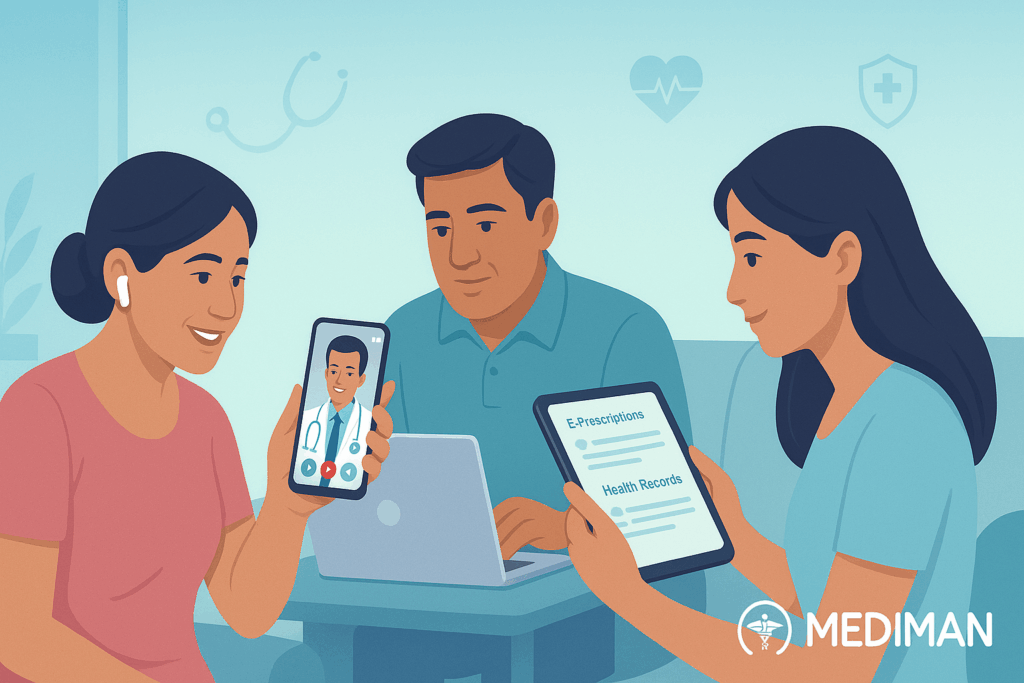
Within this broader landscape, MediMan telehealth positions itself as a secure, patient-centric digital health platform that integrates the entire continuum of care: discovering doctors, scheduling appointments, conducting video or audio telehealth consultations, processing payments, and managing post-consultation workflows.
For a family in Sri Lanka or abroad, MediMan telehealth can become the default “front door” to healthcare. Instead of searching randomly online or waiting for a clinic to open, you can:
- Select doctors by specialty, language, and availability.
- Book video appointments for direct consultations from home or workplace.
- Capture e-prescriptions and clinical notes in a single digital record.
- Store and manage your family’s health information, including children and elderly parents.
The question is no longer whether MediMan telehealth works; the strategic question is how you, as a patient or caregiver, can operationalize it in your daily life to consistently drive better health outcomes.
What Works – Five Proven Ways to Maximize MediMan Telehealth
1. Master the MediMan Platform Before You Need It
The worst time to explore features is when you are unwell or stressed. To future-proof your experience with MediMan telehealth, set yourself up while you are still feeling fine.
Start with a thorough onboarding:
- Download the MediMan patient app from your preferred app store.
- Complete your profile with accurate demographics, known allergies, and chronic conditions where applicable.
- Enable notifications so you do not miss appointment confirmations, reminders, or post-consultation instructions.
Next, familiarize yourself with the platform’s service catalog. Walk through how to:
- Search for doctors by specialty, location, language, and consultation mode.
- Choose between MediMan telehealth video visits and in-clinic appointments based on your need.
- Navigate to your prescriptions, consultation history, and any uploaded lab results.
By doing this when you are not under pressure, you build muscle memory. When an urgent issue arises, you can focus on articulating your symptoms rather than trying to figure out where to tap next. In practical terms, this means your MediMan telehealth visits become more clinical and less technical.
2. Design a Reliable, Private Setup for Every Telehealth Visit
A seamless MediMan telehealth consultation is built on three pillars: connectivity, device readiness, and privacy. If any of these fail, your clinical conversation gets disrupted, and you lose valuable minutes fixing issues instead of discussing your health.
Connectivity:
- Whenever possible, use a stable Wi-Fi network. If you rely on mobile data, check your signal strength and data balance before joining the call.
- Ask family members to pause heavy streaming or downloads during your scheduled slot.
- If connectivity is borderline, position yourself closer to the router or move to a spot with better mobile coverage.
Device readiness:
- Charge your smartphone, tablet, or laptop well ahead of time.
- Test your camera and microphone using a quick video call with a family member.
- Close non-essential apps that may slow down your device or cause sudden notifications.
Privacy and environment:
- Choose a quiet room with minimal background noise and interruptions.
- Ensure your face is clearly visible with good front lighting; avoid sitting with bright windows behind you.
- Have any physical items you may need close at hand: medications, devices like blood pressure monitors, or written notes.
By systemically standardizing your setup, every MediMan telehealth visit becomes more professional. You send a strong signal to your doctor that you are prepared and serious about your health, which often leads to more focused and productive discussions.
3. Bring the Right Health Data into Each MediMan Consultation
In an in-person clinic, nurses and doctors can read your file, examine you physically, and sometimes pull in previous reports. In a MediMan telehealth context, your clinician depends heavily on what you proactively share. That is why structured, accurate health information is your biggest asset.
Before each MediMan telehealth appointment, invest 10–15 minutes in preparation:
- Symptom log
- Capture when the problem started, how it has evolved, and what triggers make it better or worse.
- Describe the location, type, and intensity of pain or discomfort using simple scales (for example, 1–10).
- Medication list
- List all prescription medicines you currently take, including dosage and timing.
- Add over-the-counter drugs, herbal remedies, and supplements to avoid harmful interactions.
- Vitals and measurements
- Where possible, record recent blood pressure, blood sugar, weight, temperature, or oxygen saturation readings.
- Note dates and times for each reading to give your doctor a clear trend line.
- Relevant documents
- Keep recent lab reports, imaging results, and hospital discharge summaries ready.
- Where supported, upload these into the MediMan telehealth record ahead of your consultation.
This level of preparation transforms the dynamic of the call. Instead of spending the first half trying to recall details, you move directly into clinical reasoning and decision-making. Your doctor can triangulate what you say with the data you provide and design a more tailored treatment plan with fewer assumptions.
4. Communicate Clearly and Honestly with Your MediMan Doctor
In MediMan telehealth, your words, tone, and body language replace much of the traditional physical examination. Effective communication is not a “soft skill”; it is a clinical input.
Start with a concise opening statement such as:
“I booked this MediMan telehealth visit because I have had a persistent dry cough for ten days, mostly at night, and I want to understand the cause and the right treatment.”
From there, share details in a structured way:
- Symptom characteristics: What does it feel like? When is it worst? What activities or foods seem related?
- Associated symptoms: Do you have fever, breathlessness, chest pain, rashes, or fatigue?
- Recent changes: Any new medications, travel, work stress, or life events that might be relevant?
Honesty is non-negotiable. Disclosing habits like smoking, alcohol consumption, or past mental health challenges may feel uncomfortable, but it gives your clinician critical context. Remember that confidentiality still applies in MediMan telehealth just as it does in a physical clinic.
Use the video channel effectively:
- Position the camera so your doctor can clearly see your face and any visible symptoms.
- If requested, adjust the device to show rashes, swelling, or movement-related issues where appropriate.
Finally, treat clarification as a standard part of the process, not a sign of misunderstanding. Summarize what you have heard at the end of the call:
- “So I will take this medication twice a day after meals for five days, avoid driving after the night dose, and schedule a follow-up MediMan telehealth visit if the symptoms do not improve, correct?”
This simple playback ensures both sides are aligned and drastically reduces the risk of misinterpretation once the call ends.
5. Use MediMan Telehealth as Your Continuous Care Hub
The real power of MediMan telehealth emerges when you stop thinking in isolated visits and start thinking in terms of continuous care. Telehealth is most effective when it becomes the operating layer that connects appointments, lab results, lifestyle adjustments, and follow-ups over time.
Here is how to make MediMan telehealth your long-term health companion:
- Consolidate your records: Use the platform consistently so that your consultations, e-prescriptions, notes, and reports are stored together rather than scattered across multiple channels.
- Standardize follow-ups: Before you end each call, agree with your doctor on the next touchpoint—whether it is another MediMan telehealth appointment, an in-clinic visit, or a specific lab test. Book this while the context is fresh.
- Leverage digital reminders: Use app notifications and your phone calendar to track medication schedules, review dates, and long-term health goals such as weight management or blood pressure control.
- Integrate family care: Add parents, children, or dependents as appropriate, and centralize their health information so that you can act as a more effective caregiver across geographies.
By treating MediMan telehealth as the core orchestrator of your health journey, you reduce the gaps between episodes of care. Over time, this integrated view enables earlier interventions, fewer avoidable emergencies, and more strategic use of in-person visits.
Trade-offs – What Telehealth Can Do Exceptionally Well (and Where It Has Limits)
Strengths of MediMan telehealth for patients and families
From an outcomes and experience perspective, MediMan telehealth is particularly strong in several use cases that align with global evidence on virtual care:
- Access and convenience: It allows patients to connect to clinicians without the friction of travel, waiting rooms, or clinic queues, which is especially valuable for people in rural areas or working abroad.
- Chronic disease management: Conditions such as diabetes, hypertension, asthma, and mental health concerns benefit from frequent, shorter check-ins, where MediMan telehealth can deliver meaningful value.
- Family-centered care: Families can coordinate care for children and elderly parents from one digital hub, even across borders, supporting safer decision-making and better adherence.
- Continuity and data: By centralizing consultations and prescriptions, MediMan telehealth provides longitudinal insight that is often missing when patients jump between unrelated providers.
For these scenarios, telehealth is not a “second-best” option; it is often the most efficient and sustainable way to deliver continuous, high-quality care.
Situations where in-person care is non-negotiable
At the same time, a mature telehealth strategy must acknowledge its boundaries. There are clinical scenarios where MediMan telehealth can triage and guide you, but cannot replace physical examination, diagnostics, or emergency interventions.
Examples include but are not limited to:
- Severe chest pain, suspected heart attack, or stroke symptoms.
- Major injuries, fractures, heavy bleeding, or loss of consciousness.
- Acute abdominal pain with signs of shock or severe distress.
- Situations requiring immediate imaging, procedures, or intensive monitoring.
In these cases, the role of MediMan telehealth is to support decision-making before or after in-person care, not to delay it. The most responsible use of virtual care is not to force it into every scenario, but to deploy it where it is clinically appropriate, efficient, and safe. National telemedicine guidelines—including those issued in Sri Lanka—echo this framing by positioning telehealth as a complement, not a replacement, to traditional services.
Next Steps – Operationalizing MediMan Telehealth in Your Daily Life
A reusable pre-consultation checklist
To industrialize the way you use MediMan telehealth, convert best practices into a simple, repeatable checklist you can follow before every appointment:
- Platform readiness
- Logged into MediMan telehealth with updated personal and family profiles.
- Notifications enabled; upcoming appointment time confirmed.
- Technology readiness
- Internet connection tested; device charged; camera and microphone working.
- Quiet, well-lit, private room selected; headphones available if needed.
- Clinical readiness
- Symptom notes captured, including onset, patterns, and severity.
- Medication list updated, including recent changes and supplements.
- Vitals and at-home measurements recorded where available.
- Key lab reports or imaging summaries ready to be shared if requested.
- Engagement readiness
- Top three questions or concerns written down.
- Willingness to be open and honest about lifestyle factors and mental health.
This checklist turns a MediMan telehealth visit from a reactive event into a controlled process with clear inputs and expected outputs.
Building long-term digital care habits with MediMan
Beyond individual consultations, think in terms of habits and systems:
- Make MediMan telehealth the default channel for non-emergency clinical questions, chronic disease follow-ups, and report discussions.
- Use in-clinic appointments when physical examination or procedures are truly required.
- Review your digital health record periodically to ensure it reflects your current status, medications, and key diagnoses.
- Normalize telehealth within your family so that parents and children see it as a trusted route to care, not a temporary pandemic workaround.
Over time, you will notice that MediMan telehealth is not just saving travel time; it is enabling a more proactive, data-driven approach to your health where you and your clinicians can jointly monitor trends, intervene earlier, and design lifestyle changes with better accountability.
References – Evidence Behind Telehealth and Virtual Care
Multiple independent organizations and research bodies have evaluated telehealth and virtual care. Their findings consistently reinforce the strategic value of platforms like MediMan telehealth when used thoughtfully:
- The World Health Organization and other global bodies define telehealth as the delivery of healthcare services where patients and providers are separated by distance, leveraging information and communication technologies.
- Major health systems, such as Mayo Clinic and Johns Hopkins Medicine, describe telehealth and telemedicine as effective channels for remote consultations that improve convenience and maintain quality of care.
- Systematic reviews from agencies like the U.S. Agency for Healthcare Research and Quality highlight that outpatient telehealth improves access, reduces some types of hospital visits, and can match in-person care outcomes for many conditions.
- Recent studies and narrative reviews show that telehealth is particularly powerful in chronic disease management, mental health, and underserved or rural populations—areas where timely access is critical.
- National guidelines, including those developed in Sri Lanka, position telemedicine as an integrated component of health systems, with clear guidance on when remote care is appropriate and when in-person evaluation is necessary.
These references validate that when implemented through a secure, well-designed platform, telehealth is not an experimental workaround but a strategic enabler of modern, patient-centered healthcare.
Call to Action – Start Your Next MediMan Telehealth Visit the Smart Way
The future of healthcare is hybrid. Clinics and hospitals will always play a central role, but digital platforms like MediMan telehealth are rapidly becoming the primary interface through which patients and families initiate and coordinate their care. The organizations and individuals who benefit most will be those who adopt telehealth not as a one-time project, but as a standard operating model.
Your next step is straightforward:
- Download and set up the MediMan app, including profiles for yourself and your family.
- Build your personal pre-consultation checklist based on the guidance above and save it where you can reuse it.
- Use MediMan telehealth for your next non-emergency health concern or chronic disease follow-up, and deliberately apply these tips.
By doing this, you transform MediMan telehealth from a convenience feature on your phone into a strategic health asset—one that delivers faster access, better continuity, and more empowered decision-making for you and the people you care for.
Reference Links
- World Health Organization – The rise of telehealth and definition of telehealth services.
- StatPearls (NIH/NLM) – Telehealth systems and virtual platforms overview.
- Mayo Clinic – Telehealth: Technology meets health care.
- NCBI – The Evidence Base for Telehealth.
- Narrative review – Role of telemedicine and telehealth in public healthcare.
- MDPI – The role of telemedicine in transforming healthcare.
- Sri Lanka Ministry of Health – Telemedicine Guidelines Version 1.0.
- MediMan.life – Official site describing MediMan’s digital health platform and services.