
The Quick Debunk
The biggest of all virtual healthcare myths is that it’s a “lesser” version of traditional care. This is fundamentally untrue. Modern virtual healthcare platforms, like those offered by Mediman, provide licensed, high-quality, personalized, and secure medical services. Far from being “impersonal,” this model often increases patient-provider contact and improves management of chronic conditions. While it doesn’t replace in-person care for emergencies or procedures, it serves as a powerful, convenient, and effective cornerstone of modern health, dismantling old virtual healthcare myths one patient at a time. The evolution of virtual healthcare is significant, and understanding its true capabilities is the first step to better health.
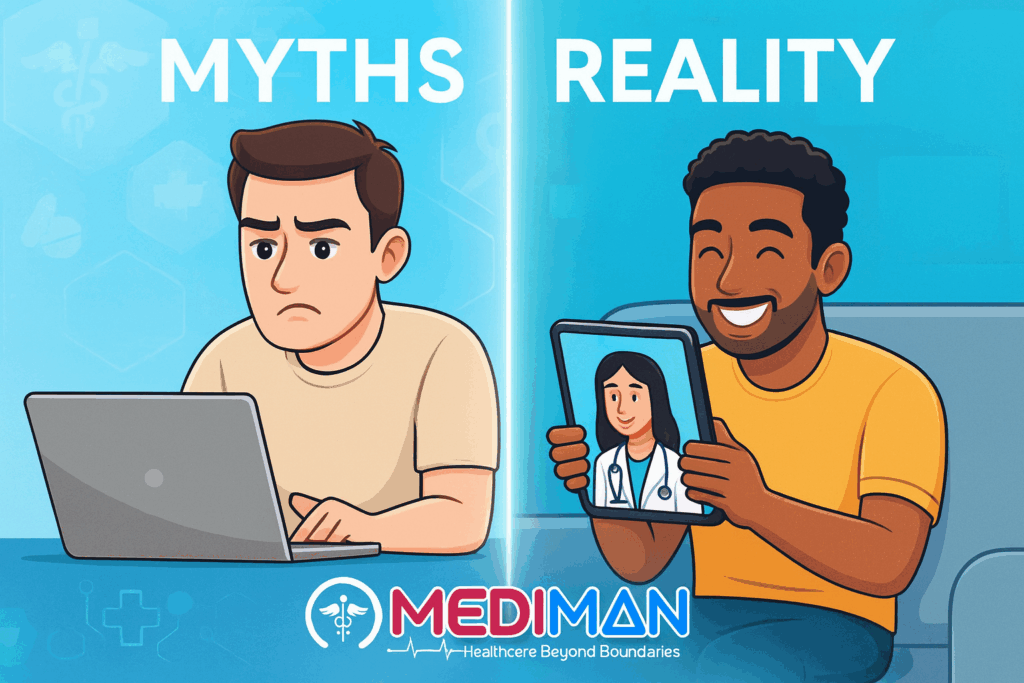
The Rise of Virtual Healthcare and Its Misconceptions
In the last five years, the term “virtual healthcare” has exploded from a niche concept into a global phenomenon. What was once a convenience for a select few is now an essential service for millions. This rapid digital transformation of medicine, accelerated by necessity, has fundamentally altered the patient-provider relationship. We now have unprecedented access to specialists, primary care physicians, and mental health professionals from the comfort of our homes. This virtual healthcare revolution promises a future that is more accessible, efficient, and patient-centric.
However, this speed of adoption has created a significant gap in understanding. With any new technology that disrupts a deeply entrenched, traditional system—especially one as personal as healthcare—a cloud of misinformation, assumptions, and skepticism is inevitable. These virtual healthcare myths are not just harmless misunderstandings; they can actively prevent individuals from seeking timely, convenient, and potentially life-saving care. They create friction, doubt, and fear, slowing the adoption of a virtual healthcare system designed to solve many of traditional healthcare’s biggest problems, such as access, cost, and convenience.
The virtual healthcare industry is vast, and not all platforms are created equal. This variation in quality, especially in the early days, helped fuel some of the most persistent virtual healthcare myths. But today, the landscape is different. The technology has matured, regulations have solidified, and providers have become experts in “webside manner.”
How Did These Virtual WHealthcare Myths Begin?
The primary virtual healthcare myths stem from a disconnect between perception and reality.
- Fear of the Unknown: For generations, “healthcare” meant a sterile room, a stethoscope, and a physical exam. The idea of a diagnosis through a screen feels foreign and incomplete to many. This psychological barrier is the root of the “impersonal” and “low-quality” virtual healthcare myths.
- Early Adopter Issues: The first wave of virtual healthcare was, frankly, clunky. Pixelated video, dropped calls, and limited functionality defined early telemedicine. Users who had a bad experience five years ago understandably believe the technology is still flawed, even though modern virtual healthcare is as different from its predecessor as a smartphone is from a pager.
- Extrapolation from Other Tech: We see data breaches in other industries and naturally fear for our health data. We experience frustrating customer service bots and assume a virtual healthcare provider will be similarly automated and impersonal. These negative associations create a baseline of distrust.
This context is critical. Understanding why people are skeptical allows us to address the core fears, not just the surface-level virtual healthcare myths. The mission of Mediman is not just to provide exceptional virtual healthcare, but to educate patients on what modern virtual healthcare truly entails, rebuilding that trust through transparency, technology, and superior care. We are moving from a system of reactive “sick care” to proactive “health care,” and virtual healthcare is the engine of that change.
The New Standard of Virtual Healthcare
The virtual healthcare of today is not a replacement for all in-person medicine. It is a powerful component of a comprehensive, hybrid care model. It excels at triage, follow-ups, chronic disease management, mental health services, and urgent care for non-emergency issues. It integrates with wearable devices, home monitoring kits, and secure patient portals to create a continuous stream of health data.
This continuous model is the antithesis of the “impersonal” myth. A patient using virtual healthcare for diabetes management might have more touchpoints with their care team in a month (via messages, data uploads, and quick video chats) than an in-person patient has in a year. This is the reality that dismantles the virtual healthcare myths.
At Mediman, we built our platform to be the standard-bearer for this new era. We didn’t just put a doctor on a video call; we re-imagined the entire patient journey. We integrated scheduling, communication, monitoring, and follow-up into one seamless, secure, and user-friendly experience. Our commitment is to show, not just tell, how effective virtual healthcare can be. We believe that every patient who uses our service will see the old virtual healthcare myths for what they are: relics of a bygone era. The future of medicine is here, and it’s built on a foundation of quality virtual healthcare.
What Works: Debunking the 5 Biggest Virtual Healthcare Myths
The gap between public perception and technological reality is where virtual healthcare myths thrive. Let’s tackle them head-on with facts, data, and the reality of how modern platforms like Mediman operate. The goal isn’t just to debunk these virtual healthcare myths, but to replace them with an accurate understanding of the powerful tool virtual healthcare has become.
Myth 1: Virtual Healthcare Lacks Personalized Care
This is perhaps the most pervasive of all virtual healthcare myths. The argument is that a screen creates a barrier, making the interaction cold, transactional, and algorithm-driven. People fear they will be treated like a case number by a random, disconnected provider.
The Reality: High-quality virtual healthcare is designed to be more personal, not less.
- Provider Continuity: Reputable platforms like Mediman are not “doctor roulette.” We believe in the power of the patient-provider relationship. Our system allows you to choose your provider and see them consistently, building the same long-term trust you would in a traditional clinic. Your doctor remembers you, your history, and your goals.
- Increased Access & Frequency: Personalization thrives on communication. With virtual healthcare, you’re no longer limited to a 15-minute, twice-a-year visit. Secure messaging allows for quick follow-up questions. A concern that might not have warranted a full in-person visit (and the associated hassle) can be addressed in a brief video chat. This continuous touchpoint model fosters a far deeper, more personalized partnership in your health.
- Focus on the Patient: In a traditional visit, a doctor spends, on average, a significant portion of the appointment typing into an EMR (Electronic Medical Record), often with their back to the patient. A well-designed virtual healthcare interface puts the patient’s data and history at the provider’s fingertips, allowing them to maintain eye contact and focus on the conversation, not the clerical work.
- Data-Driven Personalization: Modern virtual healthcare integrates with your life. By connecting to your smartwatch, blood pressure cuff, or glucometer, you and your provider get a real-world view of your health—not just a single snapshot from a stressful clinic environment. This data allows for hyper-personalized advice. A doctor can see your blood pressure trend over a week, not just one high reading, leading to more accurate, tailored treatment plans. This is a level of personalization that traditional, episodic care struggles to achieve.
The “personal touch” is not about a physical handshake. It’s about being seen, heard, and understood by a professional who is invested in your long-term health. The tools of virtual healthcare are built to enhance exactly that.
Myth 2: Virtual Healthcare Is Only Suitable for Minor Issues
This is another one of the classic virtual healthcare myths: that telemedicine is fine for a common cold, a rash, or a prescription refill, but “real” medicine requires a “real” (i.e., physical) building.
The Reality: While virtual healthcare is fantastic for urgent, non-emergency issues, its most significant impact is in managing complex, chronic conditions and mental health.
- Chronic Disease Management: Consider conditions like Type 2 Diabetes, hypertension, asthma, or high cholesterol. These are the biggest drivers of healthcare costs and poor outcomes. They are also perfectly suited for virtual healthcare. These conditions are managed by data, consistency, and lifestyle coaching. A virtual healthcare platform allows a patient to upload daily glucose readings, share food logs, and have monthly video check-ins to adjust medication—all without taking a half-day off work. Studies from leading medical journals have shown that telehealth interventions significantly improve key biomarkers (like A1c) for chronic disease patients.
- Mental Healthcare: This is a revolution in itself. Virtual healthcare has demolished the three biggest barriers to mental health services: stigma, cost, and access. A patient can now see a licensed therapist or psychiatrist from the privacy of their own home. This is particularly life-changing for those in “therapy deserts” with no local providers. The efficacy of tele-psychiatry and tele-therapy is well-established, and for many, the comfort of their own environment makes them more open and successful in treatment.
- Specialist Consultations: Need to see a dermatologist, a neurologist for a follow-up, or a post-operative surgeon? Virtual healthcare streamlines this. A “store-and-forward” dermatology consult (where you send photos) can get you a diagnosis in hours, not weeks. A post-op check-in via video saves a vulnerable, recovering patient a difficult trip to the hospital.
This isn’t “minor” care. This is the essential, long-term work of modern medicine. Believing virtual healthcare is “just for colds” is like believing smartphones are “just for phone calls”—it ignores the revolutionary applications that define its true value.
Myth 3: Virtual Healthcare Is Complicated and Technologically Challenging
This myth paints a picture of patients and elderly users struggling with complex software, glitchy video, and confusing interfaces. It’s the “I can’t even program my VCR” argument for the 21st century.
The Reality: The entire virtual healthcare industry is built on the principle of accessibility. If the platform is hard to use, the company fails.
- User-Centric Design: Mediman’s platform, like most modern virtual healthcare apps, is designed with the least tech-savvy user in mind. The interfaces are clean, the buttons are large and clear, and the process is guided step-by-step. If you can use Facebook or check your email, you have the skills to use our virtual healthcare service.
- Ubiquitous Technology: The barrier to entry is a smartphone, tablet, or computer with an internet connection. The vast majority of the population, including seniors, now own these devices. The technology is no longer a niche luxury; it’s a common utility.
- Dedicated Patient Support: This is a non-negotiable component. The source article mentioned “dedicated local customer service,” and that’s a key concept. At Mediman, we don’t just give you an app and wish you luck. Our technical support team is available to walk you through every step, from setup to connection, ensuring any “digital gap” is bridged by human support. We can help you test your camera and microphone long before your appointment, so when it’s time to talk to the doctor, you’re confident and ready.
- Proven Senior Adoption: Studies on virtual healthcare adoption during the pandemic found that seniors were not only capable but enthusiastic users of telehealth. Once they overcame the initial setup, they cited the convenience and reduced travel burden as massive benefits. The myth that older patients can’t or won’t use technology is just another one of the unfounded virtual healthcare myths—and it’s a bit ageist, to boot.
Technology is not the barrier; it is the bridge. And for those who need a hand crossing it, human support is the handrail.
Myth 4: Virtual Healthcare Compromises the Quality of Care
This is the most dangerous of the virtual healthcare myths. It suggests that a “virtual” doctor is a “worse” doctor, or that the care itself is substandard, a cut-corner service for the sake of convenience.
The Reality: Quality of care is defined by clinical outcomes, adherence to evidence-based guidelines, and provider expertise. Virtual healthcare often meets or exceeds these standards.
- Licensed, Vetted Professionals: The doctors, nurse practitioners, and therapists on virtual healthcare platforms are the same licensed, board-certified, and experienced professionals you would see in a clinic. At Mediman, all providers undergo a rigorous credentialing process. They are held to the same medical and ethical standards as any in-person provider.
- Evidence-Based Protocols: Virtual healthcare is not “medicine lite.” Providers follow the same established clinical guidelines for diagnosis and treatment. In fact, the technology often enhances this by integrating decision-support tools and the latest guidelines directly into the provider’s workflow, ensuring consistency and quality.
- Improved Accessibility = Improved Quality: Quality is irrelevant if the patient can’t access the care. By removing barriers of transport, cost, and time, virtual healthcare increases the likelihood a patient will seek care early and adhere to their treatment plan. A patient who gets their blood pressure medication refilled via a 5-minute video call—instead of skipping it for a month because they couldn’t get an appointment—is receiving higher quality and safer care.
- Documented Efficacy: The research is clear. For a vast range of conditions—from mental health to chronic disease to urgent care—studies published in journals like the New England Journal of Medicine and JAMA have shown that virtual healthcare produces clinical outcomes that are as good as, and in some cases better than, traditional in-person care.
Quality is not compromised by convenience; in many ways, it is enabled by it.
Myth 5: Virtual Healthcare Is Not Secure
In an age of constant news about data breaches, it’s logical to fear for the privacy of your most personal information: your health data.
The Reality: Reputable virtual healthcare platforms are built on a foundation of bank-grade security and must adhere to the strictest privacy laws in the world.
- Legal & Regulatory Mandates: In the United States, all virtual healthcare platforms must be HIPAA (Health Insurance Portability and Accountability Act) compliant. This isn’t an optional “nice to have”; it’s a federal law with severe financial and criminal penalties for non-compliance.
- Advanced Encryption: Your conversation with your doctor is not like a public social media post. Virtual healthcare platforms use end-to-end encryption for video calls and messages. Your data is encrypted “in transit” (as it moves across the internet) and “at rest” (as it’s stored on secure servers). This means that even in the extraordinarily unlikely event of an interception, the data would be unreadable.
- Secure Infrastructure: These platforms are not run from a basement server. They are hosted in highly secure, HITRUST-certified data centers with multiple layers of physical and digital protection.
- Safer Than Paper: It’s worth remembering that the old system of paper files and fax machines is, in many ways, less secure. A file can be lost, a fax can be sent to the wrong number, and a clipboard can be left on a desk. A secure, encrypted digital system with a clear audit trail of who accessed what, and when, is a massive security upgrade.
At Mediman, data security is our single highest priority outside of patient outcomes. We invest heavily in our infrastructure and compliance to ensure that your protected health information (PHI) stays protected. Period. Believing these virtual healthcare myths about security can, unfortunately, push people back to less secure, less efficient, and less effective models of care. The truth is, your data has never been safer.
Trade-offs: The Real Limitations of Virtual Healthcare (And How We Address Them)
To build trust, we must be honest. Debunking virtual healthcare myths doesn’t mean pretending virtual healthcare is a magic wand that can solve every medical problem. Believing it has no limitations is just as dangerous as believing the myths themselves. True E-E-A-T (Experience, Expertise, Authoritativeness, Trustworthiness) comes from transparency.
The best virtual healthcare providers are not “virtual-only”; they are “virtual-first.” They understand the technology’s limits and have built a “hybrid” model that seamlessly guides patients to in-person care when necessary.
The Need for Physical Examination
This is the most obvious and important trade-off. There are things a screen cannot do. A doctor cannot use a virtual healthcare platform to physically touch a tender abdomen, listen to a heart murmur with a stethoscope, or perform a hands-on neurological exam.
- How We Address It: Triage and integration. Our providers are experts in identifying the boundaries. If your symptoms require a hands-on exam, our job is not to guess. Our job is to refer you to the correct level of care immediately. This is not a failure of virtual healthcare; it is the success of its most important function: triage. We will help you book an appointment at a local clinic, partner imaging center, or, if your symptoms are severe, direct you to an Urgent Care or Emergency Department. Our platform’s goal is to be your first call, your “front door” to the health system, ensuring you always get to the right place the first time.
The Reality of the Digital Divide
We debunked the myth that virtual healthcare is “too complicated,” but we must acknowledge the real “digital divide.” This isn’t about skill; it’s about access. A patient without a stable internet connection or a reliable smartphone cannot use virtual healthcare services. This is a significant barrier, particularly in rural and low-income communities.
- How We Address It: This is a societal problem that requires a multi-pronged solution. While we can’t build internet infrastructure, we can design our virtual healthcare platform to be as “light” as possible, requiring minimal bandwidth. We offer phone-based consultations as a fallback. We partner with community centers, libraries, and local health clinics to create “telehealth hubs” where patients can use dedicated, high-speed equipment. We also advocate for policy changes that treat internet access as the public utility it has become.
Emergency Situations
This must be said clearly: Virtual healthcare is not for emergencies.
- How We Address It: Clear communication. If you are experiencing chest pain, shortness of breath, severe bleeding, or signs of a stroke, you should not be logging into an app. You should be calling 911. Our virtual healthcare platform makes this clear at every user touchpoint. Our providers are trained to recognize emergency symptoms immediately and will halt the virtual healthcare visit to direct you to emergency services.
By being honest about these limitations, we move past the virtual healthcare myths and into a mature, realistic conversation. Virtual healthcare is not a panacea. It is, however, the most powerful tool we have ever had for making healthcare more accessible, continuous, and integrated.
Next Steps: How to Embrace Virtual Healthcare with Confidence
You’ve seen the facts. The most common virtual healthcare myths—that it’s impersonal, insecure, low-quality, and only for minor issues—are simply not supported by the reality of modern virtual healthcare.
So, what’s next? How do you move from “myth” to “method”?
- Start Small (If You’re Nervous): You don’t have to dive in with a complex issue. Try using Mediman for your next prescription refill or a seasonal allergy flare-up. Let you first experience be a low-stakes one. You’ll quickly see how simple, secure, and professional the entire virtual healthcare process is.
- Prepare for Your First Visit: Treat it like a real appointment.
- Write down your symptoms and questions beforehand.
- Find a quiet, well-lit room where you won’t be interrupted.
- Test your connection and camera ahead of time using our built-in tool.
- Have your medications or any relevant home-monitoring data (like blood pressure readings) with you.
- Choose a “Virtual-First” Partner: Don’t just use a random service. Choose a virtual healthcare partner like Mediman that is invested in your long-term, holistic health, not just one-off, transactional visits. Look for platforms that offer provider continuity, a wide range of services (including mental and chronic care), and a clear commitment to security.
The biggest barrier to virtual healthcare is often the inertia of habit and the shadow of these unfounded virtual healthcare myths. But the benefits on the other side—convenience, access, and personalized, continuous care—are worth challenging those assumptions.
Micro-FAQs
- Can a virtual doctor prescribe medication? Absolutely. Our licensed providers can prescribe a wide range of medications for non-controlled substances (like antibiotics, blood pressure medication, antidepressants, etc.) and send the prescription electronically to your preferred local pharmacy.
- Is virtual healthcare covered by my insurance? In most cases, yes. The vast majority of insurance plans now cover virtual healthcare visits just as they do in-person appointments. Mediman partners with a wide array of insurance providers. You can check your coverage instantly on our website or by contacting our support team.
Reference Links:
- Mediman Services: Primary Care, Mental Health, and More
- U.S. Dept. of Health & Human Services (HHS) on Telehealth
- HHS.gov on HIPAA Security for Patients
- American Medical Association (AMA) – The Future of Telehealth
- World Health Organization (WHO) on Digital Health
- The New England Journal of Medicine (NEJM) – Telehealth and Chronic Disease
- JAMA – Efficacy of Teletherapy for Mental Health
- FCC.gov – The Digital Divide and Healthcare
Call to Action (CTA)
The only way to truly debunk a myth is to see the truth for yourself. Stop letting outdated virtual healthcare myths dictate your access to care. Join Mediman today, and experience the future of healthcare: personal, secure, and built around you.
Download MediMan to book your first appointment in minutes.