
The Future of Hospitals: Why Hybrid Care (In-Person + Online) Is the Next Big Thing in Healthcare
By MediMan Team6 min read
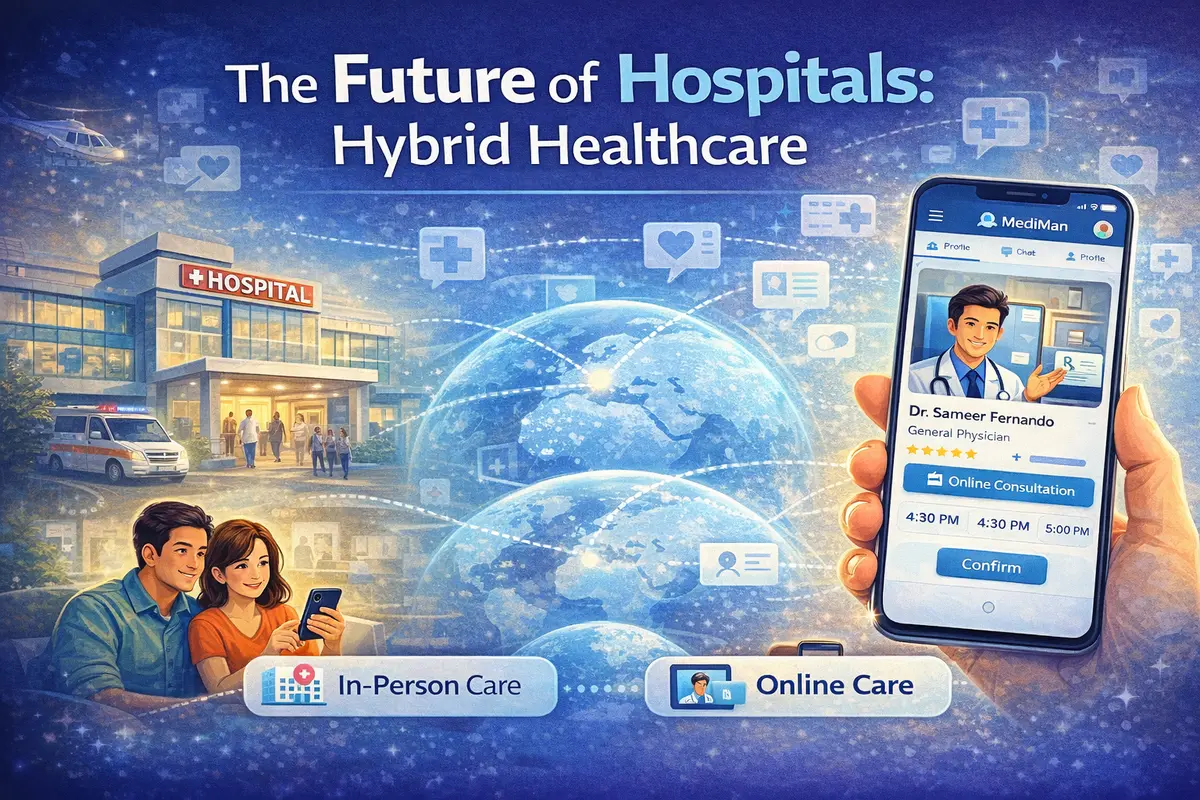
Think about how most hospital visits still work today: You travel in traffic. You wait in crowded corridors. You spend hours for a consultation that may last just a few minutes.
Now think about how the rest of your life has changed: Banking is online. Shopping is online. Learning is online. Healthcare is now catching up - but it’s not going fully online.
The real future is a hybrid healthcare model: In-person + online care working together to give you faster, smarter, safer healthcare.
This article will show you: * What hybrid care really means * Why the future of hospitals depends on both online and offline care * How this model benefits patients, doctors, and global families * How platforms like MediMan are building this future right now
What Is Hybrid Healthcare? (In-Person + Online, Not One or the Other)
Hybrid healthcare means: * You use online consultations when physical examination is not essential * You use in-person hospital or clinic visits when hands-on care is needed * All your records and appointments are connected through a digital platform
It’s not “Only telehealth forever” or “Only hospital OPD forever”.
It’s a smart mix: Online for access, convenience, follow-ups, second opinions, chronic care. Offline for emergencies, surgeries, procedures, scans, and full examinations.
In the future of telehealth, hospitals will be the care hubs, while apps like MediMan will become the digital front door.
Why Traditional “Only In-Person” Care Is No Longer Enough
The classic hospital-only model struggles with modern life: * Long waiting times * Overcrowded OPD clinics * Patients travelling long distances for short reviews * Elderly patients exhausted by queues * Diaspora families unable to be physically present
For many consults (especially non-emergency ones), this system is slow, stressful, and expensive (time + money + energy).
Yet, we all know not everything can be done online. You can’t do surgery on a video call. You still need physical exams, scans, and procedures. So the question is not “online vs hospital”. The question is: “How do we combine the strengths of both into one powerful hybrid healthcare model?”
Why “Only Online” Is Not the Answer Either
Some people imagine a future where everything is virtual. That’s dangerous and unrealistic. Things that will always need in-person hospital care include: * Emergencies (heart attack, stroke, accidents, severe breathing problems) * Operations and invasive procedures * Detailed physical examinations * Certain tests and imaging (X-ray, CT, MRI, endoscopy, etc.)
This is why the future of hospitals is not about replacing them with apps. It’s about transforming how and when we use hospitals - and connecting them with telehealth in a structured way.
The Sweet Spot: How Hybrid Care Works in Real Life
Let’s look at how a hybrid healthcare model works across a patient’s journey.
1. Before a Hospital Visit You feel unwell, but not in an emergency. Instead of going straight to OPD, you: * Book an online doctor via MediMan * Have a first consultation from home * Get guidance: “You need these tests and then a clinic visit” or “This can be managed online for now”
Result: You visit the hospital only if needed, and with clear instructions.
2. During Hospital Care For necessary in-person care, you go to the hospital for scans, procedures, or physical examination. But even here, a hybrid model helps: * App-based appointments reduce waiting * Prior online triage filters non-urgent cases * Your digital records from MediMan give doctors context before you arrive
Result: Hospitals focus more on serious and complex cases, not just crowd management.
3. After Hospital Discharge Traditionally, you go home after treatment and are told “Come back for review”. You travel back again just to show reports or ask a few doubts. With hybrid care: * Your follow-up can be online via MediMan * You upload new reports * The doctor reviews your recovery, adjusts medicines, and tells you if another physical visit is actually necessary
Result: Better recovery, fewer unnecessary trips, and continuous care instead of one big event.
How Hybrid Healthcare Benefits Patients
1. Convenience Without Compromising Safety You don’t have to choose between comfort or quality. You get online for first contact and follow-ups, and hospital for serious or hands-on care.
2. Lower Overall Cost (Not Just Money, But Energy and Time) Hybrid care saves travel costs, lost wages, and extra expenses. It saves energy and time, especially for elderly patients, parents with young children, and people with chronic illnesses.
3. Better Care for Chronic Diseases For conditions like Diabetes, Hypertension, Heart disease, Asthma, and Thyroid problems, the best model is in-person assessment at the start, followed by regular telehealth follow-ups.
4. Stronger Support for Global Families & Expats For families spread across countries, hybrid care is a lifesaver. Parents in Sri Lanka can see the doctor in-person when needed, while children abroad join online for reviews via MediMan.
How Hybrid Care Helps Doctors and Hospitals
Hybrid healthcare isn’t just good for patients. It makes life better for doctors and hospitals too.
- Less Overcrowded OPDs: Non-urgent cases shift to online slots, queues get shorter, and doctors get more time per complex case.
- Smarter Use of Doctor Time: Doctors can set online consultation hours and in-person clinic timings, using MediMan to manage both.
- Better Continuity and Loyalty: When patients have one app for all appointments and records, they’re more likely to stick with that hospital and doctor.
How MediMan Fits into the Hybrid Healthcare Future
MediMan is designed exactly for this future: not to pull people away from hospitals, but to connect users and doctors better across online and offline worlds.
- Online + In-Person Appointments in One Place: Doctors can offer both slot types. Patients choose based on need.
- Family-Friendly Hybrid Care: Manage health for parents, children, and dependants in one app.
- Cross-Border Hybrid Model: Consult Sri Lanka doctors from abroad, then visit local hospitals if needed.
- Digital Health Records: Centralized data powers the hybrid model, giving doctors the full picture.
What Will the Hospital of the Future Look Like?
In the future of hospitals, you can expect: * Digital front doors: Patients start their journey on an app * Online triage: Doctors or digital systems guide who needs to come in * Hybrid workflows: Pre-visit online, Visit in-person, Post-visit online * Data-driven care: Less paper, more insight
Telehealth and apps like MediMan won’t replace hospitals. They’ll reshape hospitals into smarter, calmer, more efficient health hubs.
Final Thought: Hybrid Care Is Not the Future - It’s Already Starting
The next big thing in healthcare isn’t a choice between online and offline. It’s a world where you see your doctor online when you can, go to the hospital when you must, and your data moves with you.
That’s the true future of hospitals and telehealth: Hybrid care that fits your life, not the other way around.
If you want to experience this future now, download the MediMan app and start using healthcare the hybrid way - book online, visit in-person when needed, and keep your entire health journey in one smart, secure place.
Frequently asked questions
Does hybrid healthcare replace in-person doctor visits?
No, it complements them. Hybrid care uses online consultations for initial assessments, follow-ups, and discussions, while reserving in-person visits for physical examinations, surgeries, and procedures that require hands-on care.
Can I use MediMan for both online and in-person appointments?
Yes, MediMan is designed to facilitate both. You can book video consultations for convenience or schedule in-clinic appointments when a physical visit is necessary, all through the same app.
Is hybrid care suitable for chronic diseases?
Often, yes. Many people with long-term conditions such as diabetes or high blood pressure have an in-person check-up first and then use online follow-ups for routine reviews, as their doctor advises. This can save some hospital trips.