
When Should You Choose an Online Consultation Instead of Visiting a Hospital?
By MediMan Team8 min read
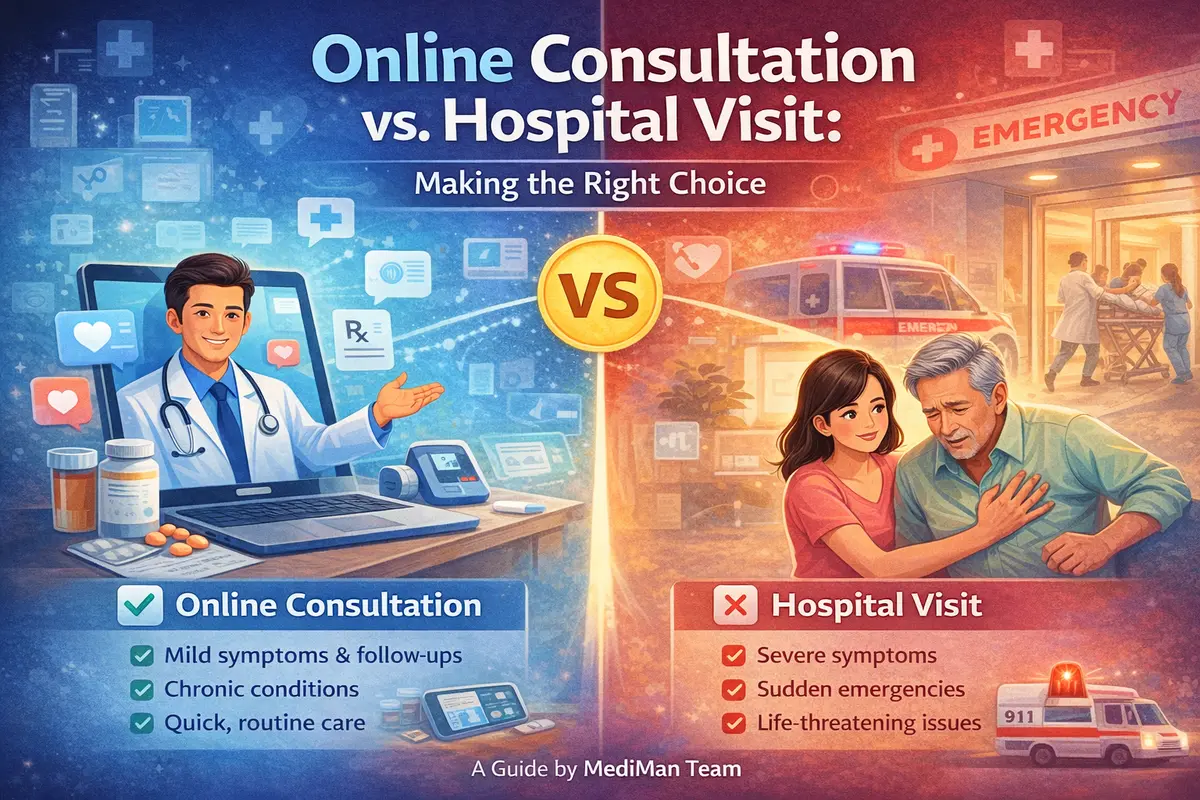
Telehealth and online doctor consultations are now normal parts of healthcare. But for many people, one big doubt remains: “How do I know when it’s okay to see a doctor online… and when I really need to go to a hospital?” Choosing correctly can save you time, money, and stress - but more importantly, it can protect your safety. This practical guide will help you understand: When an online consultation is a smart choice When you must visit a hospital or emergency department
How to decide in real life, quickly and confidently
How a platform like MediMan helps you use both options wisely
The Golden Rule: Online for Non-Emergencies, Hospital for Emergencies
Before going into details, remember this simple rule: If your condition is mild, moderate, or non-urgent → an online doctor consultation is usually suitable. If your condition is sudden, severe, or potentially life-threatening → you should go to a hospital / emergency unit immediately. Telehealth is powerful, but it cannot replace emergency care, surgery, or procedures. Think of it as a smart, convenient way to manage the majority of everyday health needs - not as a replacement for emergency rooms. Situations Where Online Consultation Is Usually the Best First Choice Here are the most common scenarios where choosing an online doctor instead of going straight to a hospital makes a lot of sense.
1. Follow-Up Visits After a Hospital or Clinic Consultation
Once you’ve already seen a doctor in person, many follow-ups don’t require another physical visit. An online consultation is ideal when you need to: Review blood tests, scans, or lab reports Discuss progress after starting a new medicine Adjust dosages of regular medication Clarify doubts about your diagnosis or treatment plan With MediMan, you can: Upload your latest reports Book a video consultation with the same or another specialist Avoid another full-day hospital trip just to “show reports”
2. Managing Chronic Conditions (Diabetes, BP, Asthma, Thyroid, etc.)
Long-term conditions like: Diabetes High blood pressure (hypertension) Heart disease (stable patients) Asthma & COPD Thyroid disorders High cholesterol …need regular monitoring and adjustments, not physical examination every single time. Online medical consultations are perfect for: Sharing home readings (BP, sugar, weight, peak flow, etc.) Reviewing lab results and ECG/cholesterol profiles Fine-tuning long-term treatment Getting lifestyle and diet counselling Instead of monthly hospital queues, you can have short, regular, structured reviews online and visit in person only when necessary.
3. Mild to Moderate, Non-Emergency Symptoms
If you feel unwell but not seriously ill, an online consultation is often a safe, efficient starting point. Typical issues include: Cough, cold, blocked nose, sore throat, mild fever Mild diarrhoea, acidity, gas, minor stomach discomfort Mild headache, muscle or joint pains Skin rashes, simple infections, mild allergies Menstrual irregularities or mild gynaecological symptoms Minor eye or ENT issues (without trauma or severe pain) A doctor can: Ask detailed questions Examine you visually over video if needed Decide if medicines, tests, or home care are enough Tell you clearly if a physical examination or hospital visit is required You save time and avoid crowding hospitals for issues that can be safely managed at home.
4. Mental Health and Counselling
For many people, visiting a mental health professional in person can feel difficult or embarrassing. Telehealth creates a more comfortable pathway. Online consultations work very well for: Anxiety, stress, burnout Mild to moderate depression Sleep problems Relationship or family conflicts Work-related stress and adjustment issues Talking to a psychologist or psychiatrist via secure video from your own space: Reduces stigma Makes it easier to attend follow-ups regularly Helps build long-term therapeutic relationships
5. Prescription Renewals & Routine Reviews
If you’re already on long-term medication and: Need a repeat prescription Want to confirm if you should continue the same medicines Need minor dose correction based on reports …an online doctor consultation is usually enough. You can: Share your current medicines Upload previous prescriptions Show recent lab tests or BP/sugar readings The doctor can then decide whether to: Renew your prescription Adjust your dose Order updated tests Ask you to come in person if something looks concerning
6. Second Opinions & Report-Based Consultations
If you’ve already visited a hospital and have: A diagnosis CT/MRI/X-ray/echo/scan reports Blood test results A surgery recommendation …but you want more clarity or another expert’s view, telehealth is ideal. You can: Upload your documents Take a second opinion online from another specialist Understand your options before making big decisions This is especially helpful when: You live far from big hospitals You’ve received conflicting advice You want to feel confident before agreeing to surgery or long-term treatment
7. When You Live Abroad or Far Away from Your Trusted Doctor
If you’re working, studying, or living abroad or in another city, you may still trust doctors from your home country or hometown. Where local regulations permit, online consultations can help you to: Stay connected with doctors who know your history and language Get guidance for non-emergency issues Manage chronic diseases with familiar doctors Platforms like MediMan are designed to make it easier for: Patients abroad to connect with doctors back home Doctors to set separate, fair fees for foreign consultations Global families to stay anchored to trusted healthcare relationships When You Should Not Use Online Consultation: Go Straight to a Hospital Online consultations have limits. Some situations are too serious, too sudden, or too risky for telehealth. You should immediately go to a hospital / emergency department (or call your local emergency number) if you experience: Severe chest pain or chest pressure Pain spreading to arm, neck, jaw, or back Sudden difficulty breathing, choking, or severe wheezing Loss of consciousness, fainting, or being unresponsive Seizures (fits), especially if first time or prolonged Stroke warning signs: Sudden weakness or numbness on one side of the body Sudden trouble speaking or understanding Sudden severe headache or loss of vision Major accidents or injuries, suspected fractures, serious head injury Heavy or unstoppable bleeding Severe abdominal pain with persistent vomiting or fever Serious burns, electric shock, poisoning Any situation where your instinct says: “This could be life-threatening.” In all these cases, every minute counts. Do not use telehealth as a first step - go straight to emergency care.
What About “In Between” Situations?
Sometimes symptoms feel “not that mild, but not extreme”. In such borderline cases, use this logic: If symptoms have been slowly building and you’re stable (able to talk, walk, breathe normally) → you can oftenstart with an online consultation. If symptoms are sudden, rapidly worsening, or frightening, or you feel “this is not normal at all” → go to a hospital. When in doubt and you’re not in obvious immediate danger, you can still start with an online doctor. If they suspect something serious, they will tell you clearly to seek urgent in-person care. A Simple 4-Step Checklist: Online Doctor or Hospital? Use this quick mental checklist:
1. Is this suddenly severe or potentially life-threatening?
Yes / not sure but feels very serious → Hospital / emergency now No → go to Step 2
2. Do I need stitches, plaster, surgery, or emergency procedures?
Yes / maybe → Hospital / clinic No → go to Step 3
3. Is this mainly about reports, follow-up, chronic disease, doubts, or mild/moderate symptoms?
Yes → Online consultation is suitable No / still unsure → go to Step 4
4. Can I comfortably sit, speak, and wait 10-20 minutes without feeling worse?
Yes → You can start with an online consultation No → Go to hospital This isn’t a medical device, but it’s a good, practical guide for everyday decision-making.
How MediMan Makes Choosing Online Care Easier and Safer
A good telehealth platform should not just give you a video call - it should make your whole healthcare journey easier. Here’s how MediMan supports that: 1. Clear Doctor Profiles and Specialties You can: Search doctors by name, specialty, hospital, or location View their qualifications, experience, and languages Choose someone who fits your needs and comfort level This helps you avoid “random” online consultations and instead make informed choices. 2. Online and In-Person Options in One Place Doctors on MediMan can list: Online consultation slots In-person clinic times and locations You decide: “This problem is simple, I’ll book online.” “This needs a physical check, I’ll go to the clinic.” Both are managed from one app, with one unified history. 3. One App for the Whole Family With MediMan, you can: Add parents, spouse, children, and dependants Book appointments on their behalf Keep each person’s medical records neatly separated but easy to access This is especially useful when: You live in one city/country and parents live in another Siblings share responsibility for elders You want to coordinate care as a family instead of alone 4. Digital Records for Smarter Decisions No more lost reports or half-remembered prescriptions. MediMan lets you: Upload lab results, scan summaries, and discharge cards Store e-prescriptions from online and offline visits Build a long-term health history for better, safer treatment decisions Whether you see a doctor online or visit them at a clinic, your history travels with you. 5. Designed for Global, Modern Healthcare For patients living abroad or in different cities, MediMan: Helps you stay connected with doctors you trust back home (where allowed) Allows doctors to structure separate fees for foreign patients Supports a hybrid model of care: online + in-person, local + cross-border Healthcare becomes something that moves with you, not something you leave behind when you change countries.
Frequently asked questions
1\. Can an online consultation fully replace a hospital visit?
No. It works very well for non-emergency issues, follow-ups, chronic care, second opinions, and mental health, but emergencies and serious physical problems require a hospital.
2\. Will the doctor be able to diagnose me correctly online?
For many conditions, yes - especially when based on history, visible signs, and reports. If the doctor feels a physical exam is essential, they will ask you to come in person.
3\. Is it safe to get prescriptions online?
On responsible platforms like MediMan, only verified doctors issue e-prescriptions. These are typically valid at pharmacies according to your country’s regulations.
4\. What if my online doctor tells me to go to a hospital?
Follow that advice immediately. Online consultations are sometimes the first step in triage. If the doctor is concerned, don’t delay.
5\. Is my data safe on MediMan?
Telehealth platforms like MediMan are built with secure logins, encrypted data transfer, and strict privacy controls to protect your personal and medical information. --- Final Takeaway: Use Online Consultations Wisely, Not Blindly The question is not:
“Should I always use online doctors instead of hospitals?”
The real question is:
“How can I use online consultations for everything that canbe safely done online - and keep hospitals for what must be done in person?”
When used wisely: You save time, money, and energy Doctors can focus hospitals on serious cases Your family gets continuous, connected care Healthcare starts fitting into your life, instead of disrupting it With MediMan, you can: Find trusted doctors Choose online or in-person visits as needed Manage your entire family’s health Keep all your reports and prescriptions in one secure place If you’re ready to make smarter choices about when to go online and when to go to hospital: Download the MediMan app, book your first online consultation, and experience how convenient and safe telehealth can be when used at the right time.